Market researchers have sorted consumers by generation for decades. Boomers, Millennials, Gen Z: the labels sit in audience briefs, brand plans, election models and media buys as if a birth year could tell you what someone wants. A new study asks the awkward question for anyone who sells those segments. What if the people inside a category have less in common with each other than the label suggests?
The study is Electric Twin’s Gen Z is Unbound, released on November 12 and picked up a week later in Moses Sternstein’s Charts of the Week at a16z under the blunt headline “There is No Gen Z.” It rests on 51,929 survey responses from Gen Z through Boomers in the US, UK, France and Germany, collected in two online-panel waves (January 30 to March 6 and April 22 to 26, 2026) with quotas for age, region and education. Young consumers still exist as an age group. The trouble is that treating them as one market may hide more than it shows.
What the Study Found
The headline figure comes from a matching exercise. Put 100 American Boomers in a room and ask them 13 questions on politics, immigration, the economy, abortion and AI. About 20 will find someone whose answers match theirs on every question. Do the same with 100 American Gen Z respondents and only nine will. The pattern holds in all four countries. Boomers found a perfect match roughly 15 to 20% of the time, Gen Z between 6.7% and 9.6% (the UK was highest). A Gen Z respondent is also about as likely to find a match among Boomers as among peers. On these questions, the age label adds almost nothing.
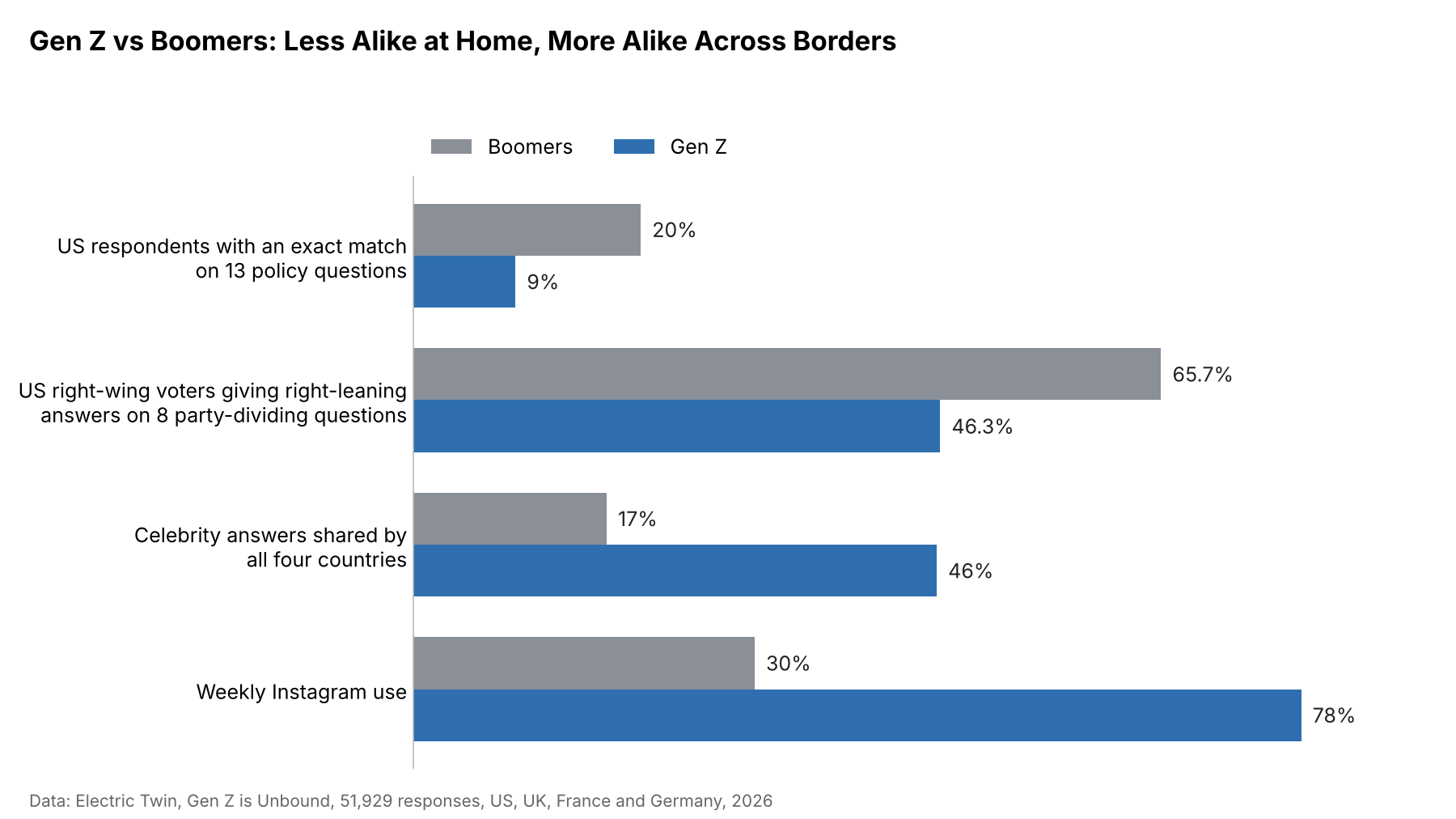
Party labels lose their grip too. In the US, right-wing Boomers gave the right-leaning answer on eight party-dividing questions 65.7% of the time. Right-wing Gen Z voters did so 46.3% of the time. Knowing which party a young person votes for tells you much less about where they stand on any one issue.
Then comes the twist. Across the same 13 questions, the share of Boomers taking each side differed between the four countries by an average of 11 percentage points. For Gen Z the gap was 4 points. The a16z chart makes the same point from another angle: political answers predict a Boomer’s nationality about 42% of the time, a Zoomer’s only 29%. So young people are spread out inside each country, yet look alike across countries on average. Pop culture points the same way. Asked to name celebrities, 46% of Gen Z answers were names that came up in all four countries. For Boomers it was 17%.
| Measure | Boomers | Gen Z |
|---|---|---|
| US respondents with an exact match on 13 policy questions | about 20 in 100 | about 9 in 100 |
| US right-wing voters giving the right-leaning answer on 8 party-dividing questions | 65.7% | 46.3% |
| Average gap between the four countries on 13 policy questions | 11 points | 4 points |
| Celebrity answers shared by all four countries | 17% | 46% |
| Online platforms used weekly (out of 21) | 3.0 | 6.2 |
| Weekly Instagram use | 30% | 78% |
Why It Might Be Happening
Media habits are the obvious suspect, though the data can’t prove cause. Gen Z respondents used 6.2 of 21 online platforms a week on average, Boomers 3.0. Weekly Instagram use was 78% against 30%. Broadcast TV and national papers used to hand big groups the same reference points. Feeds, creators, group chats and niche platforms now give people of the same age, on the same street, very different information diets. A 24-year-old who follows gaming creators, one deep in finance commentary and one whose feed is beauty and local politics may share little beyond the box they’re filed in. We’ve seen the same shift on the video side, where YouTube is now the biggest thing on American TV screens (see online video trends in 2026).
It also explains the cross-border sameness. The same platforms and often the same creators reach a 20-year-old in Lyon and one in Leeds. Geography splits audiences less than it used to. The feed splits them more.
What It Means for Segmentation
For the research business this is less a youth-culture story than a question about which variables define a market. Age is still useful for sampling, life stage, legal eligibility and plenty of spending categories. Geography still drives income, distribution, regulation and what’s on the shelf. Neither should stand in for motives, trusted sources, purchase triggers or willingness to pay. A retailer running one campaign for all 18-to-29-year-olds may find that buying context and price sensitivity explain conversion better than birth year. A media company may find creator affinity predicts retention better than age does.
The cross-border finding is the more practical one. If young audiences in four countries share celebrities and platforms more than their parents did, a creator-led campaign may travel across markets better than a country-by-country plan built on national habits. The unit worth researching is the community that forms around a set of influences, wherever its members happen to live.
Better segmentation doesn’t mean inventing dozens of trendy “tribes” and calling it done. It means collecting behavioral and attitudinal measures next to the standard demographics, checking that clusters hold up in fresh samples, and asking whether they predict anything the client cares about. Run a demographic-only model against one that adds media sources, interests, needs and brand relationships. If the richer model doesn’t predict better out of sample, or doesn’t move campaign results, it hasn’t earned its cost.
Limits, and a Word About the Sponsor
The headline has limits. This is an online, quota-sampled panel from four Western markets, not a census of young consumers. It’s cross-sectional, so it can’t separate being young now from belonging to a generation (Electric Twin says as much). The exact-match figure depends on which 13 questions were picked and how a match was defined; it doesn’t count viable consumer segments. Political views aren’t shopping behavior. And social media as the cause is still a hypothesis that needs longitudinal evidence.
Then there’s who’s talking. Electric Twin sells synthetic audiences, AI models of real populations that clients query instead of fielding a survey. A finding that demographics are too crude to target with suits that pitch. The study’s co-author, Michael Muthukrishna of NYU and the LSE, is the company’s chief science adviser. And the a16z newsletter that gave it reach comes from the firm of Marc Andreessen, who took part in Electric Twin’s $10 million round led by Atomico earlier this year. None of that makes the data wrong. It’s a familiar pattern, the same one we found in four vendor surveys on missed AI returns, where each sponsor’s research found the problem its product fixes. Buyers should know it before they adopt the conclusions.
Synthetic Respondents Raise the Stakes
The industry is adopting synthetic respondents and AI insight tools fast, and this study is a fair test case for them. A finer model can produce finer-looking segments without making better predictions. If the survey behind a synthetic audience misses a community, the model can reproduce the gap with great fluency. Electric Twin reports scoring 92% on a full-distribution accuracy measure against a 94% human test-retest benchmark, but that benchmark was led by its own science adviser. The test hasn’t changed. Check claims against well-designed human data, disclose sampling and model limits, and validate predictions against what people actually do.
So the useful takeaway isn’t “there is no Gen Z.” There’s a generation. There may be no single Gen Z consumer to aim at. The research firms that do well will know when a demographic explains something, when it stops explaining it, and which extra questions show the market under the average. That’s harder than putting a generation label on a slide. It’s also what market research was meant to do in the first place.
