A survey is the easiest research tool to run and the easiest to get wrong. Anyone can send a form. Getting an answer you can trust takes a few decisions up front.
1. Who are you asking?
Define the population first. “Small business owners in the US who pay for accounting software” is a population. “People” is not.
Then ask how you’ll reach them. This is where most surveys go wrong. If you survey your newsletter subscribers, you’ve learned about your newsletter subscribers. Online panels are fast and cheap but skew toward people who like taking surveys. Note who you can’t reach, and say so in the results.
2. How many do you need?
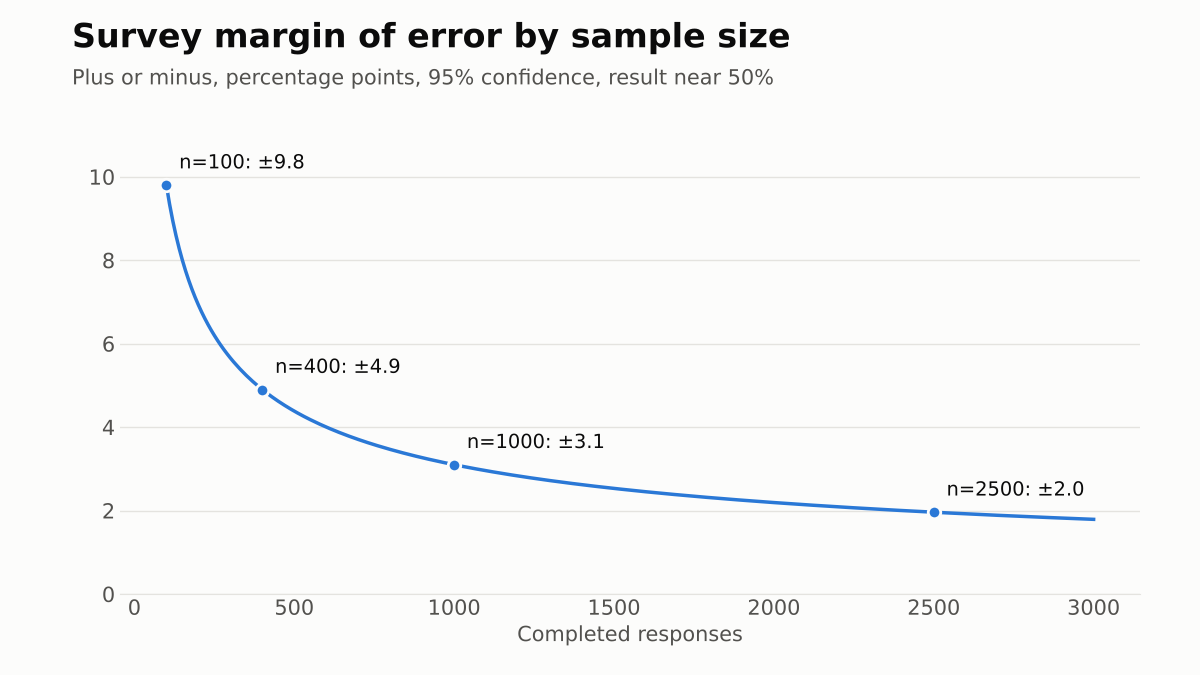
It depends on how precise you need to be, not on the size of the population.
| Completed responses | Margin of error (about, at 95% confidence) |
|---|---|
| 100 | plus or minus 10 points |
| 400 | plus or minus 5 points |
| 1,000 | plus or minus 3 points |
| 2,500 | plus or minus 2 points |
That margin applies to the whole sample. If you want to compare groups, say small and large companies, each group needs enough responses on its own. And the margin only covers random sampling error. It says nothing about a biased sample or a bad question. More in margin of error explained.
3. Write questions people can answer honestly
- Ask about the past. “How many times did you order takeout last month?” beats “How often do you order takeout?”
- One thing per question. “Is the app fast and easy to use?” is two questions.
- No leading words. “How much did you enjoy…” assumes they enjoyed it.
- Balanced scales. As many negative options as positive ones, with a real middle.
- Let people say “don’t know.” Forcing an answer creates fake opinions.
- Watch the order. Earlier questions color later ones. Put general questions before specific ones.
4. Keep it short
Every extra minute costs you completions, and the people who stay are less typical. Ten minutes is a lot. Cut every question that doesn’t connect to the decision you’re making.
5. Test it
Before launch, have five people from the target group take it while you watch or listen. You’ll find confusing wording, missing answer options and questions nobody understands. This is the cheapest fix you’ll ever make.
6. Field it and watch quality
Online surveys attract speeders, bots and people clicking through. Add an attention check, look at completion times, and drop obviously junk responses before analysis. Report how many you dropped.
7. Read the results carefully
- Check differences against the margin of error before calling them findings.
- If your sample doesn’t match the population on things like age or company size, weight it, and say you did.
- Look at the full question wording when you report a number. Small wording changes move results.
- Report the sample size, dates, method and who paid. That’s what lets anyone judge the result.
Before you survey, talk to people: see how to conduct market research. For how other people’s surveys hold up, see Study Watch.
