Formulaic social media content has become easier to spot in 2026. The same opening question, rapid captions, dramatic pause and promised payoff recur across TikTok, Instagram Reels and YouTube Shorts. These formats are efficient, which explains why creators keep using them.
Generative AI has accelerated the copying. It is now cheap to turn one idea into a week of videos, images and captions. Yet marketing surveys show growing concern that more production is making differentiation harder. That changes the business case for another polished, familiar clip.
Why Creators Repeat Winning Formats
A familiar format gives a viewer an immediate clue about what comes next. An unboxing, a reaction video or a short tutorial needs little explanation. That cuts the risk of losing attention during the first few seconds. It also helps a production team plan output and gives advertisers a recognizable place to put a product.
Creators can see view counts and retention curves, then change the next post to resemble whatever worked. Large platforms provide editing templates, trending audio and creative suggestions that lower the cost of imitation. Recommendation systems decide what gets distributed, although an individual creator cannot know the precise weight assigned to every signal.
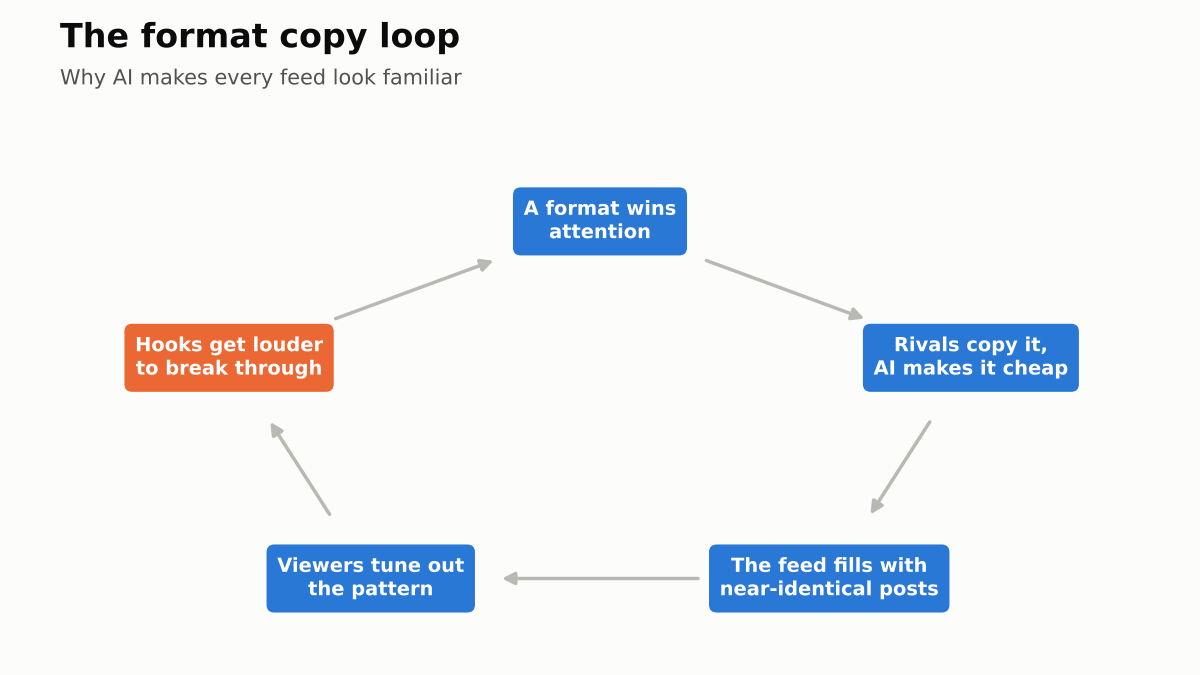
The result is a feedback loop. A format earns attention, competitors reproduce it, and viewers become accustomed to the rhythm. Then the same rhythm needs a stronger claim or more aggressive editing to make an impression. This is a commercial tendency, rather than proof that audiences dislike original work.
The AI Content Factory Meets a Crowded Feed
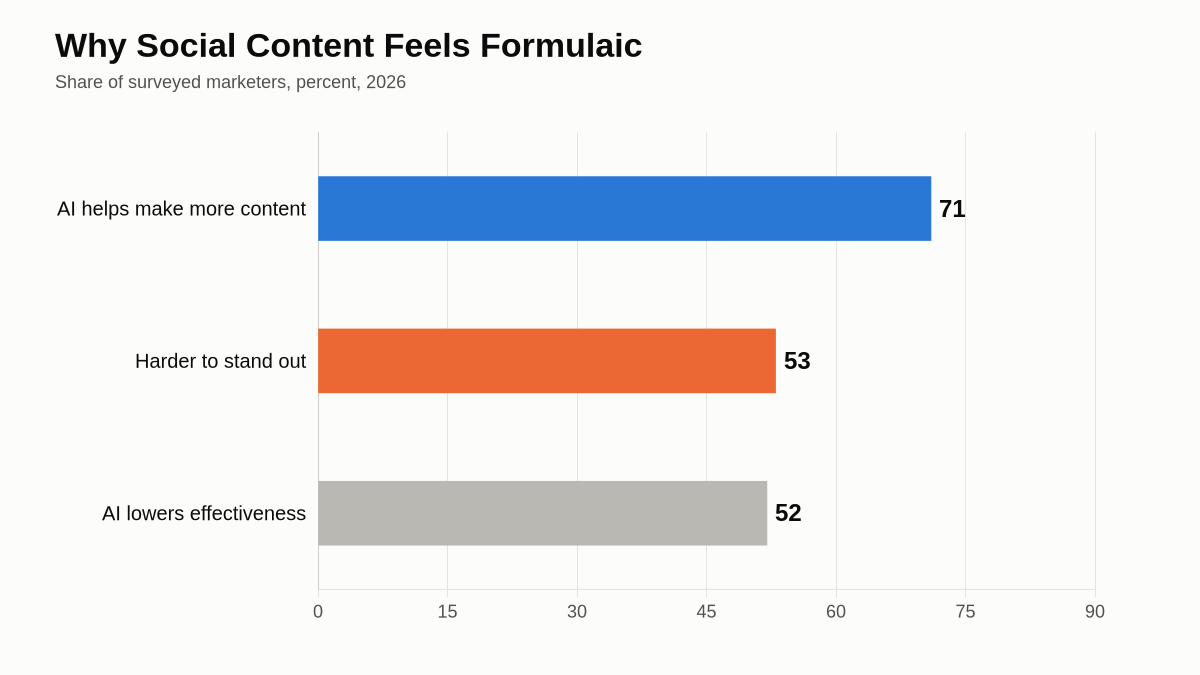
A 2026 survey of marketing teams reported that 71 percent viewed AI as a way to create significantly more content. In the same research, 53 percent said they struggled to distinguish their material in an AI-saturated market, while 52 percent believed easier AI production had made content less effective overall. These were surveyed opinions, not observed declines in advertising conversion.
| 2026 marketer response | Share | Business implication |
|---|---|---|
| AI helps create much more content | 71% | Publishing capacity rises |
| Hard to stand out amid AI content | 53% | Distinctive ideas become more valuable |
| Easy AI output reduces effectiveness | 52% | Volume alone is a weak success measure |
Two businesses may now use similar tools to generate equally competent product demonstrations. The difference will come from the reporting behind the clip, the actual product being demonstrated, or the person audiences trust. Production quality is becoming easier to buy. Credibility takes longer to build.
This explains the tension between scale and identity. A brand needs repeatable processes to publish regularly, but a factory of interchangeable posts can erase the reason a customer remembers that brand. Even a modest creator with original footage or a distinctive point of view can win attention when larger competitors publish endless variations of the same script.
The Platform Tradeoff for Publishers
In 2026, social platforms are also important routes to news. A recent US survey found that 59 percent of adults get news through social media at least sometimes. Publishers therefore have real reasons to work with short-video conventions. But reducing every report to a familiar emotional reaction risks losing the distinction between a journalist’s findings and an influencer’s performance.
The Netflix formula problem offers a parallel in long-form entertainment, where dependable production patterns may fill a catalog without delivering much conversation. Social media compresses the same pressure into seconds. The audience still decides what it watches, but distribution tools strongly shape which options become visible.
Publishers can use recognizable formats without surrendering the work behind them. A food creator can use a familiar first shot, then show an actual recipe test. A technology publisher can open with a standard product comparison, then bring its own benchmark data. The Media Business coverage will keep tracking how platform rules affect those choices.
Brands should measure repeat viewers, meaningful actions and direct visits alongside raw reach. They should also ask whether a viewer could identify the publisher if the logo were removed. If the answer is no, another five videos produced with AI may only make the problem bigger.
The cost of publishing has fallen. The cost of earning a reputation has not. Creators with a clear subject, recognizable voice and evidence of firsthand work can turn that difference into a real advantage, even when a competing feed looks slicker at first glance.
