Disney built much of its animation identity from stories that existed long before the company. Fairy tales, folklore and classic literature supplied familiar characters, while Disney added designs, songs and a recognizable commercial style. The approach has supported some enormous box office successes.
In 2026, the business case is less predictable. Several live-action adaptations have earned more than a billion dollars worldwide, but a familiar title can also underperform badly. The recent results point to the limits of treating a public domain story as a guaranteed franchise.
How Familiar Stories Became Expensive Film Franchises
The original stories behind Cinderella, Snow White, Beauty and the Beast and Alice in Wonderland are part of a long cultural history. Different writers and collectors shaped them before the modern film industry existed. A studio can draw on these underlying tales without buying exclusive ownership of a centuries-old plot. The value comes from a new production that audiences want to see.
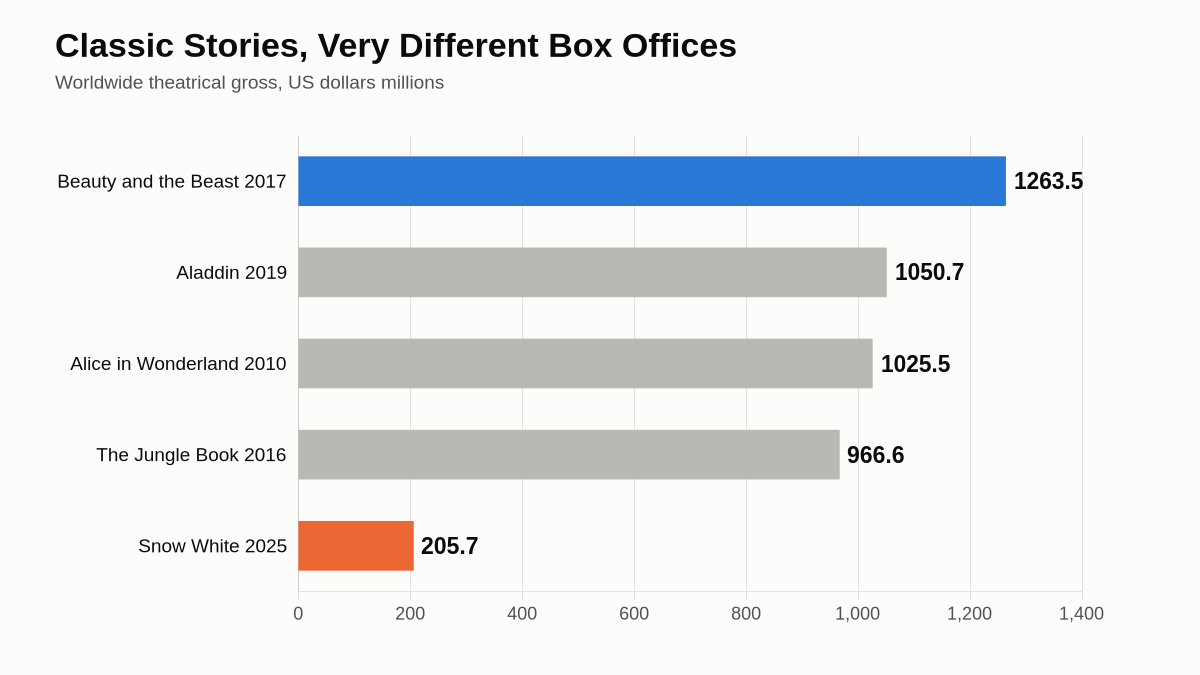
Disney’s 2010 Alice in Wonderland earned about $1.025 billion worldwide. The 2016 version of The Jungle Book approached $967 million. Beauty and the Beast reached about $1.264 billion in 2017, and Aladdin earned about $1.051 billion in 2019. These are theatrical grosses, before cinemas retain their share and before marketing or production bills are paid.
| Film | Release year | Worldwide box office |
|---|---|---|
| Alice in Wonderland | 2010 | $1.025 billion |
| The Jungle Book | 2016 | $967 million |
| Beauty and the Beast | 2017 | $1.264 billion |
| Aladdin | 2019 | $1.051 billion |
| Snow White | 2025 | $206 million |
The figures show the strength of a recognizable property when the timing, casting and execution work together. They also show why the billion-dollar label needs care. Revenue earned by one adaptation is not the total economic value of its underlying public domain story, and box office receipts do not include all later streaming, licensing and merchandise activity.
Public Domain Does Not Mean the Disney Version Is Free
A filmmaker can generally adapt public domain material, subject to the law in the relevant country. That does not confer permission to reproduce Disney’s protected animation, character designs, songs, film scripts or logos. Copyright in a new adaptation can coexist with an older story that anyone may retell. Trademark and unfair-competition rules can create additional boundaries.
Several works often placed casually on lists of public domain Disney adaptations need a qualification. Mary Poppins originated in books whose copyright history is different from ancient folklore. Moana draws from Polynesian cultural traditions, which should not be treated as a free commercial warehouse of interchangeable myths. The Lion King contains recognizable dramatic themes, but calling it a straightforward public domain adaptation of Hamlet exaggerates the connection.
These distinctions matter to creators. A studio may use a familiar premise and still need originality in the characters, music and production. It also needs cultural judgment. A film that borrows an old story without understanding its audience or source traditions can attract attention for the wrong reasons.
Why the Remake Business Now Faces a Harder Test
The 2025 live-action Snow White earned about $205.7 million worldwide, far below the billion-dollar results of several earlier reworkings. One result cannot establish a permanent decline in demand, but it disproves the idea that an old title automatically assures blockbuster revenue. The contrast is especially stark when the studio must fund an expensive production and a global release campaign.
Remakes can still introduce an old story to viewers who missed an earlier film. They can also extend the commercial life of a studio’s own film characters through games, themed attractions and streaming. Yet repeating a previously successful treatment carries a risk: viewers may feel they have already seen the definitive version.
For creators and smaller publishers, the useful lesson is that the raw material may be widely available while the distinctive execution remains scarce. The Gaming and Entertainment desk covers related franchise economics, and our Media Business coverage follows how studios handle their libraries.
Disney’s billion-dollar adaptations represent a remarkable use of shared cultural material. Their newer uneven results make the next question harder: what does a new film add to a story audiences already know? That is the question that determines whether another remake feels like an event or an expensive repetition.
