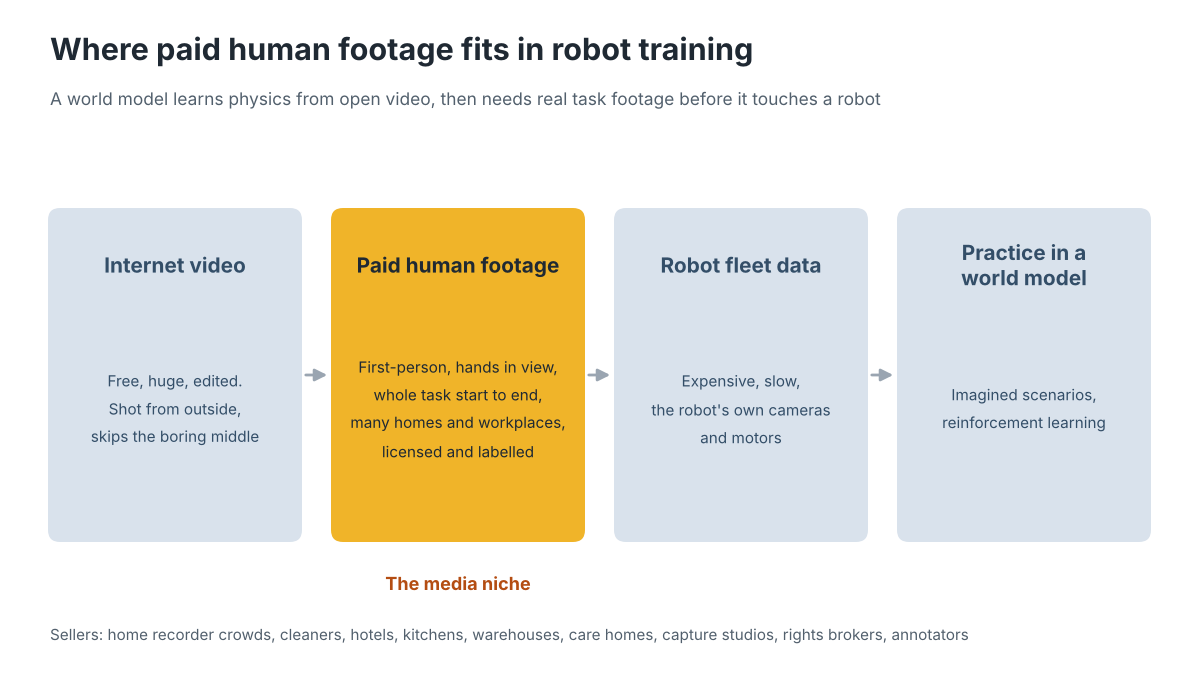
Embo came out of stealth on November 23 with a $110 million seed round led by Andreessen Horowitz, with Khosla Ventures, DST Global and NVIDIA in the round. That is a big number for a seed. What it buys is a bet on video. Embo wants to build the “brain” for general-purpose robots, a world model pretrained from scratch on internet-scale video, then fine-tuned on data from its own humanoid fleet and sharpened with reinforcement learning. The pitch is simple enough: watch enough of the physical world and you learn how objects behave and how a task unfolds. Then practise the motor skills in imagined scenarios before touching anything real.
The company names no target jobs. No customers either, and no deployment dates. But anyone who has followed robotics this year can fill in the blank. The first jobs these robots are being taught are the dull ones. Folding laundry, loading a dishwasher, wiping a table, stacking boxes, sorting parcels. Menial work, in other words, and the market for footage of people doing it has quietly turned into a business of its own.
Footage of chores is now a product
Over the past year a supply chain has formed around first-person video of ordinary work, what the industry calls egocentric data or human data. The kit is cheap: a head strap, a phone or a GoPro, sometimes Meta’s Project Aria glasses. Workers get a task list (cooking, cleaning, gardening, pet care) and are told to keep their hands in frame.
Micro1, a Palo Alto data company, says it has about 4,000 contractors it calls robotics generalists in homes across 71 countries, sending in more than 160,000 hours of video a month, and contractors are expected to file at least 10 hours a week. Scale AI and Encord have built their own recorder networks. DoorDash pays some of its delivery drivers to film themselves doing chores. In India, factories have started strapping cameras to line workers so robot developers can learn their jobs. China has gone the state route, with plans for at least 60 robot training centres where workers in VR headsets and exoskeletons walk humanoids through opening a microwave.
Still, the people buying say it’s nowhere near enough. Billions of hours is the figure that keeps coming up, and that’s for household chores alone, before you get to work involving other people.
Why Embo’s approach doesn’t kill the niche
Here is the obvious objection. If Embo can learn from internet video, which is free, why would anyone pay for footage of a man in Lagos folding towels?
Because internet video is the wrong kind of video for a lot of this. Most of it is filmed from the outside, edited, and cut at the interesting bit. A cooking channel skips the twenty minutes of washing up. A cleaning influencer shows the before and after. Robots need the boring middle, shot from roughly where their own cameras sit, with both hands visible, the grip, the slip, the second attempt. They need the same task filmed in many different kitchens (a broom in India is not a broom in Ohio). And they need footage somebody has the right to sell.
Embo’s own recipe says as much. Pretraining on the open web gets a model a general sense of physics. The fine-tuning step still runs on robot experience gathered in the real world. Between those two layers sits a gap that paid, purpose-shot, well-labelled human video fills cheaply, and research groups keep publishing results showing egocentric human data can match or beat far more expensive teleoperation for pretraining. The cheaper and better world models get, the more of this footage they can actually use.
Where the money is
Think of it as stock footage for machines. The buyers are robot labs, which are well funded right now; investors put more than $6 billion into humanoids in 2025 and the rounds keep getting larger. The sellers can be a lot of people who never thought of themselves as media producers.
- Contract crowds filming household tasks, the model Micro1 runs today. This is the volume end and pay is thin.
- Businesses that already do menial work at scale: commercial cleaners, hotel housekeeping, laundries, restaurant kitchens, warehouses, care homes. They have the environments and the staff, and footage from real workplaces is exactly what home-shot clips lack.
- Specialist production outfits that design capture protocols, run multi-camera rigs with motion tracking, and deliver clean, synced, annotated sessions. This is closer to a studio business than a gig app.
- Rights and consent brokers. Every clip has a face, a home, a family member walking past, sometimes a factory floor full of people who never agreed. Licensing that cleanly is a service in itself.
- Annotation and curation, labelling objects, hand poses, distances and task boundaries, which is where firms like Micro1 and Objectways make much of their margin.
Geography matters in an odd way. With most customers in the US, some buyers pay more for footage shot in American homes, on the theory that American households will buy robots first. So the cheapest labour isn’t automatically the most valuable footage. Variety and relevance to the buyer’s market count for more.
The catch
This is not a pleasant niche to look at too closely. The people filming are, very literally, recording how their own jobs are done so a machine can do them later. Rates are low. Privacy at home is a constant negotiation. And in Indian factories the same footage is already being reused to score workers on productivity, which tells you where the incentives point once the camera is on.
There’s also a shelf-life question. If world models trained mostly on open video keep improving, the premium on paid capture may shrink to the hard cases: dexterous work, rare environments, safety-critical tasks. That would push the niche away from volume and toward specialist production. Which is probably the more durable business anyway.
For a media company the takeaway is fairly plain. A whole new audience has appeared for footage nobody used to want, the unedited, unglamorous record of ordinary work. Embo’s seed round is one more sign that the labs building robot brains have money to spend, and that a lot of it will flow to whoever can film the dishes properly. We follow the AI infrastructure side of this story at marketanalysis.com.
