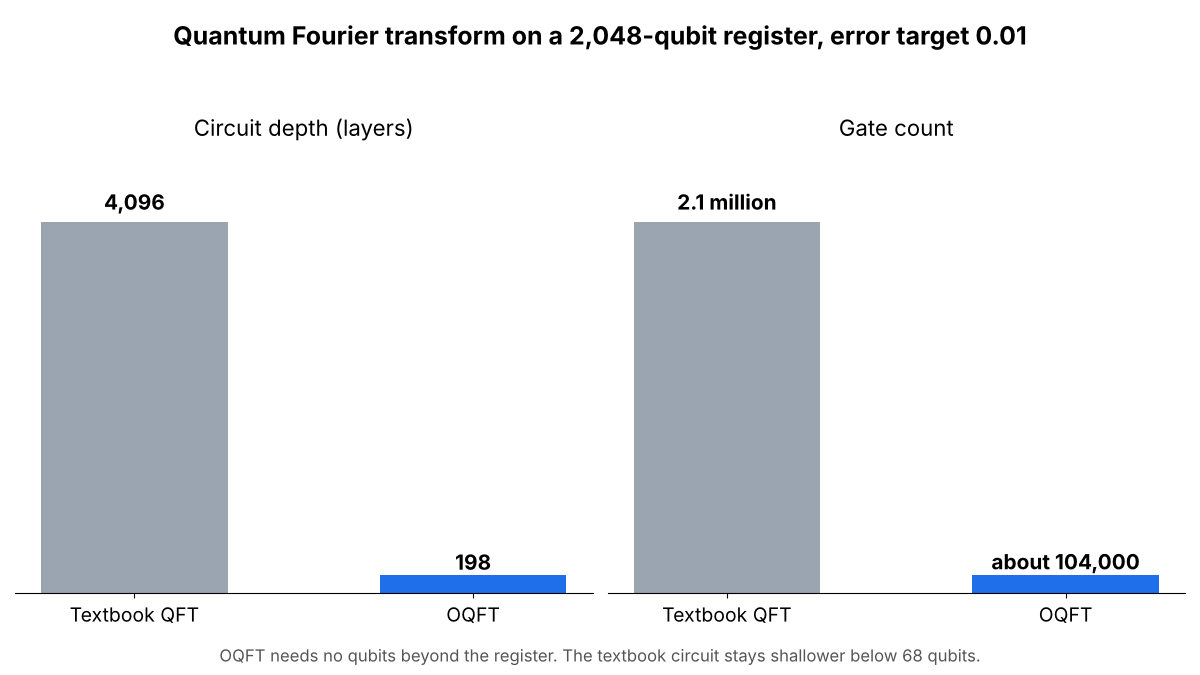
Shor’s algorithm ends with a quantum Fourier transform. That’s the step that reads out the hidden period, and in its textbook form it is deep. On a 2,048-qubit register it runs 4,096 layers and about 2.1 million gates.
OQFT is the studio’s first quantum project. It builds the optimistic QFT, a version that is right on almost every input and far cheaper. The trick: cut the register into blocks, keep only the rotations between neighbouring qubits, and run every block at once.
Three releases went out on November 13, one after another. By the end of the day the tool could build the circuit, size it from an error target and show you where it breaks.
What each release does
| Version | What it adds |
|---|---|
| 0.1 | Circuit model, simulator, textbook QFT and the approximate QFT |
| 0.2 | The optimistic QFT, sized from an error target you set |
| 0.3 | oqft check, which runs inputs through the simulator and shows where the optimistic circuit fails |
Circuits come out as OpenQASM 3. A Qiskit example loads them and checks the matrix against Qiskit’s own QFT, so you don’t have to take the numbers on trust.
The numbers, and the catch
| 2,048 qubits, error target 0.01 | Textbook QFT | OQFT |
|---|---|---|
| Depth | 4,096 layers | 198 layers |
| Gates | about 2.1 million | about 104,000 |
| Extra qubits | none | none |
That’s about 20 times fewer gates. Tightening the error target tenfold costs 24 to 32 more layers, which is cheap.
Now the catch. Below 68 qubits the textbook circuit is actually shallower, so for small demos OQFT buys nothing. And the inputs where it fails sit at the top of a block’s range, exactly where theory says they should. That’s the point of oqft check: you see the failures instead of guessing at them.
Who it’s for
People who compare circuits for a living. Researchers writing a paper can build a QFT comparison table with one shell loop. Qiskit users can drop the circuits straight into their own work. It ships as one Go binary for Linux, macOS and Windows, under Apache 2.0, and every release is built and smoke-tested by the release workflow.
Next on the list is a resource estimator for factoring. That matters more than it sounds. The heavy bill in Shor’s algorithm is still the modular arithmetic, so a cheaper QFT alone doesn’t bring Q-Day closer. What it does is take the readout step off the list of things to worry about, and an estimator would put the whole cost in one place.
All the studio’s projects are listed on our Software Projects Desk.
