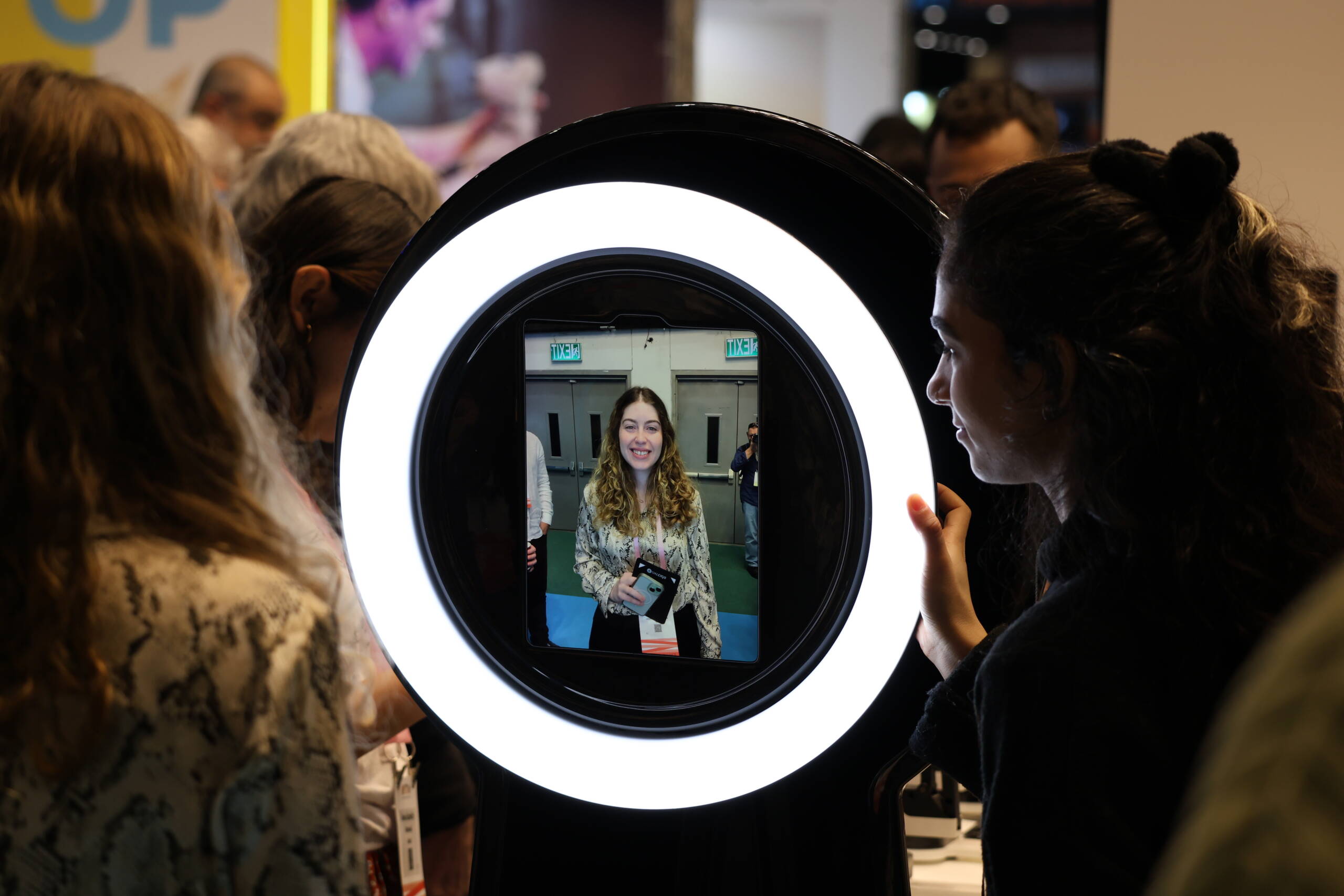
A bright circular ring of light cuts through the dim, busy atmosphere of a tech conference floor, instantly separating one small zone from the surrounding chaos. At its center stands a glossy black AI selfie station, almost sculptural, with people leaning in from both sides. Inside the glowing halo, a screen shows the result everyone is waiting for: a caricature portrait generated on the spot, smiling back with slightly exaggerated features, playful but still recognizably human. The attendant who just stepped up is framed perfectly, her real face replaced momentarily by an AI interpretation that feels personal, sharable, and oddly flattering. Around the device, shoulders overlap, heads tilt forward, and conversations pause mid-sentence. On one side, a staffer grips the edge of the station, eyes fixed on the screen, half operator, half host. On the other, blurred figures and badges dissolve into background texture, a reminder that this tiny circle of light has temporarily won the fight for attention in a room full of competitors.
At every tech event, the floor looks the same at first glance: endless booths, glowing screens, roll-up banners promising disruption, innovation, scale. Then you notice the anomaly. A small crowd has formed where there shouldn’t be one. People are smiling, phones are out, shoulders are angled inward instead of drifting past. Something is pulling them in. Attraction-grabbing stations, whether it’s an AI selfie device, a live demo with instant output, or a playful interactive tool, quietly outperform traditional marketing because they flip the logic of the event. Instead of asking for attention, they earn it by creating a moment people want to step into.
The real marketing value isn’t the gadget itself, it’s the physics of human behavior it triggers. A glowing ring light, a screen showing a caricature forming in real time, a quick transformation from attendee to participant—these elements turn passive foot traffic into an audience. Crowds beget crowds. Once two or three people stop, others slow down, curiosity does the rest. Suddenly your booth isn’t selling a product, it’s hosting an experience. And experiences are sticky. People remember how something made them feel far longer than what a banner headline said. An AI caricature printed, emailed, or shared on social media becomes a branded artifact that travels far beyond the venue, carrying your logo and your story with it, casually, without feeling like an ad. That’s marketing leverage you don’t get from a brochure.
There’s also a subtle psychological shift at play. When attendees interact with an attraction station, they lower their guard. They’re not being pitched, they’re being entertained, recognized, reflected back through technology. That moment of personal relevance opens the door for conversation. Sales teams often underestimate how powerful this is. A thirty-second playful interaction can create more goodwill than a perfectly rehearsed five-minute explanation. From there, real conversations happen naturally. “How does this work?” becomes “What else do you do?” and suddenly the product discussion feels earned rather than forced. The station acts as an icebreaker, a filter, and a qualifier all at once, pulling in people who are genuinely curious rather than politely trapped.
In a crowded tech conference where attention is the scarcest resource, attraction-grabbing stations function like attention infrastructure. They compress your message into something visible, immediate, and human. They give attendees a reason to stop, a reason to engage, and a reason to remember you after the event noise fades. Making the most of a tech event today isn’t about having the biggest booth or the loudest screen. It’s about creating a small, well-lit moment where someone feels seen, involved, and a little delighted, then letting that moment do the marketing for you.
Upcoming technology conferences:
- Israel Tech Week Miami (ISRTW), April 27–30, 2026, Miami, Florida
- Data Centre World London, 4–5 March 2026, ExCeL London
- Hannover Messe: Trade Fair for the Manufacturing Industry, 20–24 April 2026, Hannover, Germany
- DesignCon 2026, Feb. 24–26, Santa Clara Convention Center
- NICT at Mobile World Congress 2026, March 2–5, Barcelona
- Sonar Summit: A global conversation about building better software in the AI era, March 3, 2026
- Cybertech 2026: Proof That the Industry Is Finally Catching Up With Reality
- Chiplet Summit 2026, February 17–19, Santa Clara Convention Center, Santa Clara, California
- MIT Sloan CIO Symposium Innovation Showcase 2026, May 19, 2026, Cambridge, Massachusetts
- Humanoid Robot Forum 2026, June 22–25, Chicago
