Museums are quietly approaching a breaking point, even if they rarely admit it out loud. Masterpieces are aging, materials are weakening, insurance costs are exploding, and every major loan has begun to look like a high-stakes operation rather than a cultural exchange. At the same time, demand for access to art has never been higher, especially from places that don’t sit on centuries of accumulated heritage. This tension between fragility and demand is now baked into the museum system itself, and it’s why every proposal to move a great object sparks public anxiety, political drama, and conservation panic. The question is no longer whether museums can keep doing this, but whether they should.
As preparations continue for the Bayeux Tapestry’s first-ever journey to Britain, the decision to move the fragile medieval masterpiece has triggered growing backlash, including a public warning from David Hockney, who argues that transporting a 950-year-old embroidered linen across the English Channel exposes it to unnecessary and potentially irreversible risk. The 224-foot-long visual chronicle of the Norman Conquest, which has remained in France for nearly a thousand years, is scheduled for a 10-month loan to the British Museum later this year, a plan initially met with excitement but increasingly overshadowed by concerns about its extreme fragility, with critics now questioning whether the symbolic and diplomatic value of the loan truly justifies the conservation dangers involved.
The Bayeux Tapestry’s first-ever journey to Britain, surrounded by anxiety, insurance schemes, and conservation fears, exposes exactly why parallel museums built around exact replicas and immersive context may be the only sustainable way to share humanity’s most fragile masterpieces without repeatedly risking their physical survival.
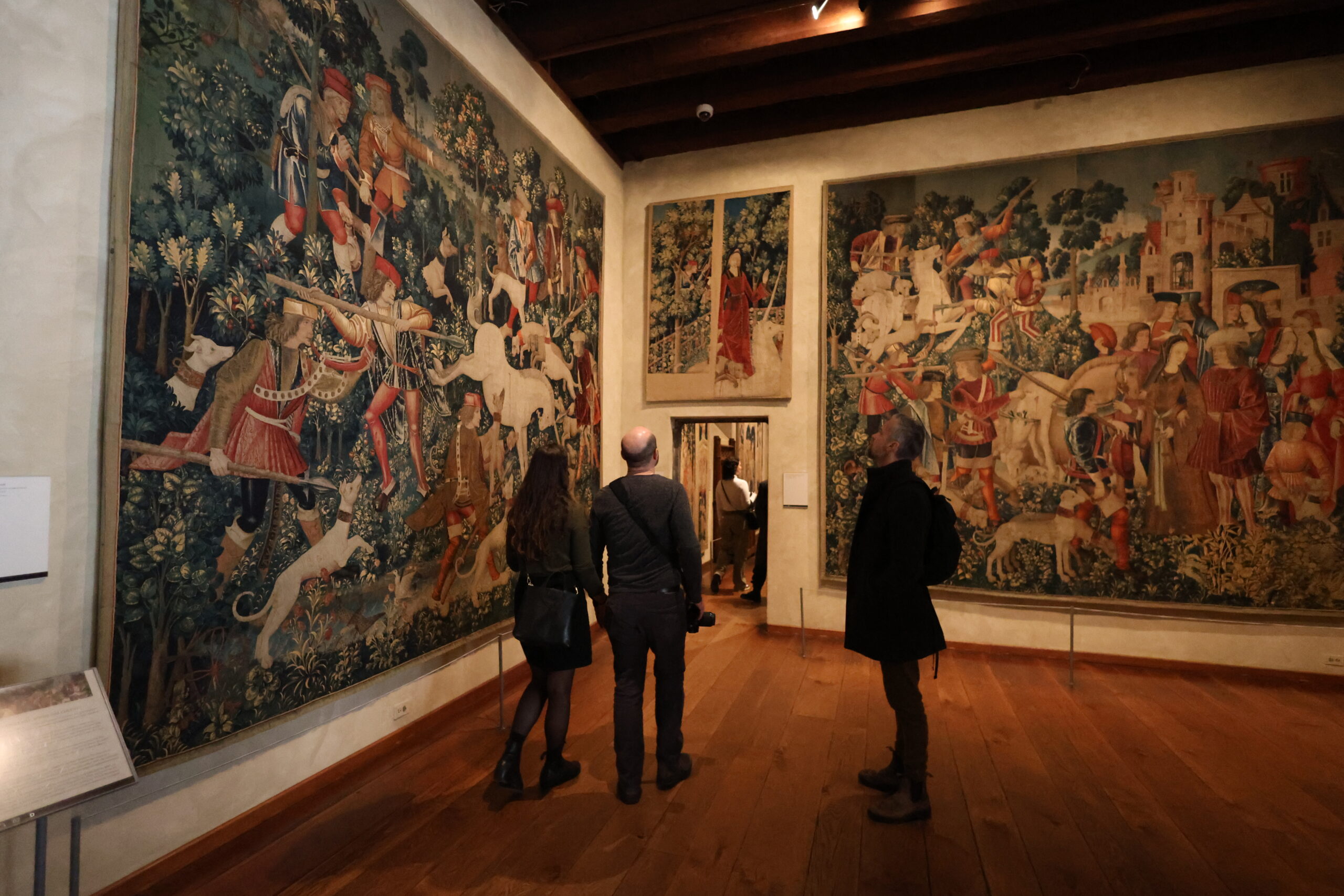
David Hockney’s suggestion cuts through the tension in a very Hockney way: why not just make a copy? “It is not difficult,” he said, breezily, proposing a fresh, identical version of the Bayeux Tapestry that could tour without fear and look “fantastic” doing it. The line sounds almost flippant until you sit with it for a moment and realize how deeply it unsettles the entire logic of museums as we’ve known them. The irony, of course, is that such a copy already exists, and almost nobody talks about it. In Reading, quietly and without drama, the museum holds a stitch-by-stitch Victorian reproduction of the tapestry, free to enter, patiently waiting for visitors who rarely come in crowds. That forgotten replica is more than a curiosity; it’s a crack in the wall of museum orthodoxy. It exposes something we’re reluctant to admit: that what people seek in museums is not simply visual information, because that can be replicated endlessly, but a feeling of contact with time itself, the shiver of standing in front of something that has survived nearly a millennium of wars, regimes, damp stone walls, revolutions, and neglect.
But once you accept that this feeling is real and powerful, another question follows almost immediately: why must it be limited to a handful of global cities that already overflow with history? Why should access to cultural gravity be restricted by geography, wealth, or the accidents of empire? This is where the idea of mass-creating duplicates stops sounding like heresy and starts sounding like infrastructure. Imagine parallel museums, purpose-built spaces in places without deep historical layers of their own, where high-quality physical replicas of major artworks coexist with multimedia, sound, scent, light, and narrative. Not screens replacing objects, but objects amplified by context. A Bayeux Tapestry copy that stretches across a hall while projections show how it was stitched, maps animate the Norman advance, voices read chronicles in Old French and Old English, and visitors are allowed to walk close enough to see thread logic instead of being held back by ropes and alarms. The copy becomes the key, not the compromise.
This model would quietly solve many of the conflicts that now paralyze cultural exchange. No more insurance schemes that rival defense budgets, no panic every time a masterpiece crosses a border, no political bargaining disguised as loans. Originals could stay where they are safest, while copies carry the story outward. And not cheap copies, not souvenirs, but obsessive, reverent reproductions made with the same seriousness medieval workshops once applied to the originals. We already do this in science, in architecture, in data preservation, yet art is still treated as if it must remain singular to remain sacred. But perhaps sacredness is not located in the object alone, but in the care taken to transmit its meaning.
Parallel museums would also address a quiet inequality that rarely gets named: entire regions of the world are expected to consume global culture through screens alone. They can watch documentaries, scroll images, maybe see a traveling show once in a generation, but never develop a physical relationship with heritage. Copies would not erase aura; they would distribute it. Just as books didn’t destroy storytelling and recordings didn’t destroy music, reproductions would not destroy art. They would free it from scarcity as a governing principle. The Victorian copy in Reading is proof that this has always been possible. Its failure is not conceptual, only institutional. It was made in the wrong era, before we knew how to build experiences around it.
The real revolution would not be technical but psychological. We would have to stop treating copies as lies and start treating them as bridges. Originals would remain anchors, deep and immovable, but their stories would finally be allowed to travel without fear. In a world where culture is increasingly unevenly distributed, parallel museums might be the most radical act of preservation we have left: not locking history down, but letting it multiply.
Here is a mock proposal for the inaugural exhibition of the first Parallel Museum.
We have designed this proposal to demonstrate the unique value proposition of the concept: doing what traditional museums cannot. It focuses on gathering scattered masterpieces into a single space—an “impossible retrospective”—and offering sensory intimacy that would be illegal with originals.
PROJECT PROPOSAL: VERMEER UNBOUND
The Inaugural Exhibition of The Parallel Museum
Date: October 2026 – March 2027
Proposed Location: The Parallel Pavilion, Mexico City (Polanco District)
Status: Concept Phase / Funding Round A
1. Executive Summary
“Vermeer Unbound” proposes a curatorial feat that is physically and financially impossible for traditional institutions: gathering all 34 known works of Johannes Vermeer in a single room, simultaneously.
Because Vermeer’s surviving works are scattered across 18 museums in 7 countries (from The Louvre in Paris to The Frick in New York), and because many are too fragile to travel, no human being—not even Vermeer himself—has ever seen them all side-by-side.
Using forensic-grade 3D textural printing and hyper-spectral imaging, The Parallel Museum will create “haptic clones” of these works. This exhibition will allow visitors to experience the Dutch Golden Age not as distant observers behind velvet ropes, but as intimate guests in the artist’s studio.
2. The Core Value Proposition
Why visit a museum of copies? Because the copy allows for intimacy.
-
Zero Barriers: All 34 paintings will be hung without protective glass casings.
-
Zero Distance: Visitors may stand within inches of the canvas to examine the famous “pearl” or the milkmaid’s pour.
-
Perfect Lighting: Without the fear of UV damage fading the pigments, we can light the works to simulate the actual daylight of a Delft afternoon, rather than the dim, conservation-safe gloom of traditional galleries.
3. Exhibition Zones
Zone I: The Camera Obscura (The Immersion)
-
The Concept: Before seeing the art, visitors enter the mind of the artist.
-
The Experience: A physical reconstruction of Vermeer’s studio in Delft. The room is dark, lit only by a single window (as seen in his paintings).
-
The Tech: Visitors look through working replicas of 17th-century camera obscuras, seeing the world flattened and illuminated just as Vermeer did. This trains the eye to understand his optical techniques before seeing the results.
Zone II: The Impossible Room (The Collection)
-
The Concept: The complete oeuvre in chronological order.
-
The Experience: A stark, minimalist gallery. All 34 works are present.
-
The “Parallel” Difference:
-
The Tactile Station: Beside key paintings (e.g., Girl with a Pearl Earring), there is a “Tactile Swatch.” This is a 1:1 textural print of a section of the painting that visitors are encouraged to touch. They can feel the cracked varnish (craquelure) and the raised impasto of the white lead paint, experiencing the topography of the masterpiece.
-
Zone III: The Forensic Lab (The Science)
-
The Concept: Treating the copy as a bridge to understanding.
-
The Experience: A digital dissection of The Music Lesson.
-
The Tech: Giant projections show X-ray and Infrared reflectography layers of the painting, revealing the changes Vermeer made (pentimenti). Because we are not worshipping the object’s sacredness, we can deconstruct it. Visitors can “scrub” through layers of the painting using gesture control, stripping away centuries of varnish to reveal the original cool blues beneath.
4. Technological Methodology
We are not using “posters.” We are partnering with leaders in Elevated Printing Technology (EPT) (e.g., Canon Production Printing / Factum Arte).
-
Data Source: High-resolution photogrammetry and 3D scans authorized by holding institutions (Rijksmuseum, Mauritshuis, etc.).
-
Materiality: Prints are created layer-by-layer using UV-cured ink to replicate the exact height and depth of the brushstrokes (up to 5mm relief).
-
Varnish: A manual application of museum-grade varnish ensures the light refracts off the surface exactly as it does on the original oil paint.
5. Logistics & Economics
This model disrupts the ballooning costs of the art world.
| Cost Driver | Traditional “Blockbuster” Loan | “Vermeer Unbound” (Parallel) |
| Insurance | $3.5 Billion (Indemnity) | $50,000 (Property coverage) |
| Transport | Armed couriers, climate crates, cargo jets | Standard FedEx/DHL crates |
| Conservation | 5 years of negotiation & risk assessment | Zero risk to heritage |
| Carbon Footprint | Massive (Courier travel + heavy cargo) | Minimal (Data transfer + local assembly) |
6. The Ask (Next Steps)
We are seeking $12.5M in seed funding to secure licensing rights for the high-fidelity scans and to commission the fabrication of the “First Generation” Vermeer set.
Outcome:
The set created for this exhibition will not be dismantled. After its run in Mexico City, the entire show packs into two standard shipping containers and tours to Lagos, Jakarta, and Mumbai—bringing the Dutch Golden Age to audiences who may never obtain a visa to visit the Netherlands.
7. Projected Revenues and ROI
Unlike traditional blockbuster exhibitions, which are financial “sinkholes” (burning cash on insurance, couriers, and climate control that disappears once the show closes), The Parallel Museum operates as an asset-generating platform.
The $12.5M seed funding is not an expense; it is a capital investment in a durable, touring asset (“The Vermeer Set”) that retains its value and utility for 10+ years.
7.1 The Economic Shift: Low OpEx / High Margin
The “Parallel” model inverts the traditional museum cost structure:
-
Traditional Museum: 80% of budget goes to Logistics/Insurance (invisible value); 20% to Experience.
-
Parallel Museum: 10% of budget goes to Logistics (standard freight); 90% to Experience & Fabrication.
-
Result: Once fabricated, the “Vermeer Set” costs negligible amounts to move. Every ticket sold after the break-even point is high-margin revenue.
7.2 Revenue Streams
A. Gate Receipts (Primary)
Based on a conservative estimate of 250,000 visitors per 6-month residency (approx. 1,400 daily) with a tiered pricing strategy averaging $22 USD (adjusted for local purchasing power parity in markets like Lagos or Jakarta).
-
Projected Revenue per City: ~$5.5 Million
-
Projected 3-Year Tour (6 Cities): ~$33 Million
B. “The Parallel Store” (High-Value Retail)
We move beyond keychains and tote bags. Because we own the printing data, the gift shop becomes a gallery. Visitors can purchase:
-
“Studio Swatches”: 1:1 textured 3D prints of details (e.g., just the Eye from Girl with a Pearl Earring) – Price point: $50–$150.
-
“Master Editions”: Full-scale, textured replicas of select works for private collectors or interior design – Price point: $2,500+.
-
Projected Revenue: Estimated at 15% of Gate Receipts ($825k per city).
C. Licensing & B2B Fees
The “Vermeer Set” can be leased to corporate HQs, universities, or luxury hotels during “dark weeks” between major exhibition stops, ensuring the asset never sits idle.
7.3 ROI Analysis (5-Year Horizon)
| Phase | Activity | Investment (Cost) | Revenue (Conservative) | Net Position |
| Year 1 | R&D, Scanning, Fabrication (The $12.5M Ask) | ($12.5M) | $0 | ($12.5M) |
| Year 1.5 | Launch: Mexico City (6 Months) | ($1.2M Ops) | $5.5M (Gate + Retail) | ($8.2M) |
| Year 2 | Tour: Lagos & Jakarta | ($1.5M Transport/Ops) | $11.0M | + $1.3M (Break Even) |
| Year 3 | Tour: Mumbai & Seoul | ($1.5M Transport/Ops) | $11.0M | + $10.8M |
| Year 4-5 | Continued Touring / Lease | ($3.0M Ops) | $22.0M | + $29.8M |
Conclusion:
We project a Break-Even Point (BEP) at Month 22 (mid-way through the second tour stop). By the end of Year 5, the “Vermeer Unbound” asset is projected to generate a 3x return on the initial seed capital, while simultaneously funding the fabrication of the next Parallel Collection (e.g., The Complete Frida Kahlo).
This is not just an exhibition; it is a self-sustaining engine for cultural access.
