When this page was last written, the high performance computing story was the arrival of exascale: machines that can do a billion billion calculations a second. That happened. The US got there first with Frontier, then El Capitan. In 2026 the story moved twice. China took the top spot back, and the biggest computers on earth stopped showing up on the list at all.
China is No. 1 again
In June 2026 a Shenzhen system called LineShine debuted at No. 1 on the TOP500, ending El Capitan’s run. It was the first Chinese machine to lead the list since Sunway TaihuLight in 2017. It runs on Chinese LingKun processors and a LingQi interconnect, so no US chips are involved, which is the point after years of export controls.
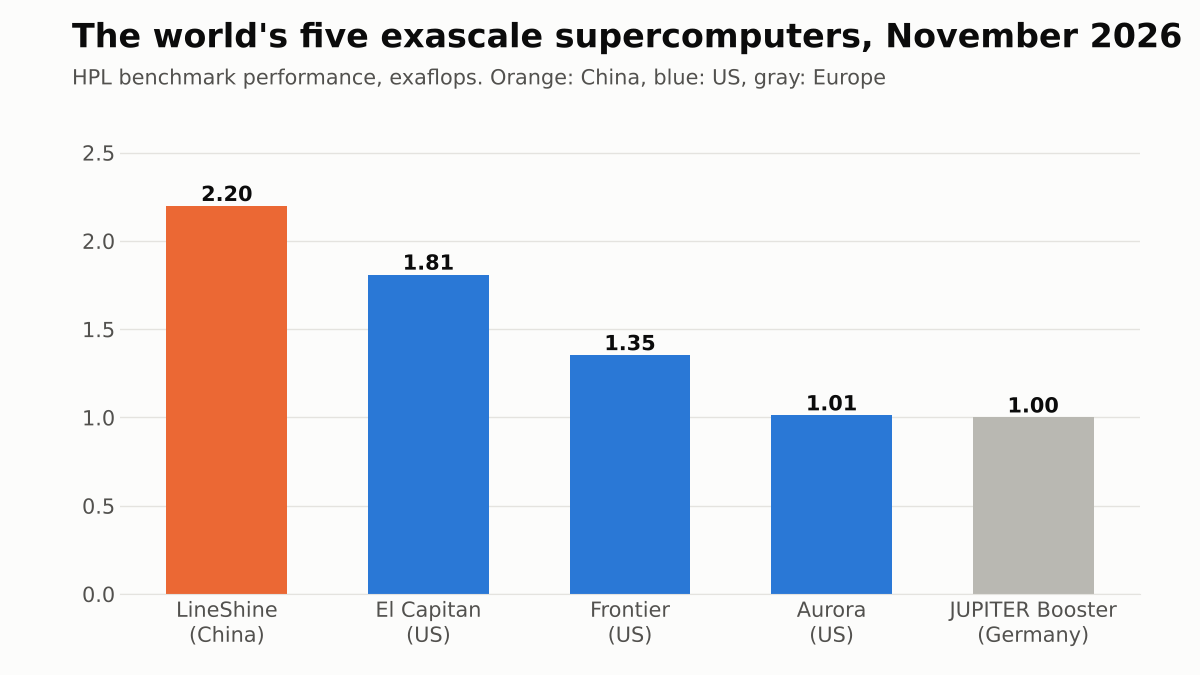
The November 2026 list kept LineShine first at 2.198 exaflops, with El Capitan second at 1.809. Five systems now pass an exaflop: LineShine, three US Department of Energy machines, and Europe’s JUPITER Booster in Germany, which crossed the line in November 2025. On a mixed-precision test closer to AI work, El Capitan still leads at 16.7 exaflops.
The list is going quiet
The more telling number is turnover. The November list had only 27 new systems, 5.4% of the TOP500, the lowest ever, and the whole top 10 stayed exactly where it was in June. The entry bar still rose, to 2.857 petaflops.
That doesn’t mean computing slowed. It moved. The largest machines now are the AI clusters built by Microsoft, Google, Amazon, Meta, OpenAI and xAI, with hundreds of thousands of GPUs. Their owners don’t spend days running the Linpack benchmark for a ranking. The list’s own organisers say growth has shifted to AI factories that never submit results. So the TOP500 now tracks government and research supercomputing more than computing power as a whole.
US labs buy like cloud customers
The Department of Energy answered by changing how it buys. Instead of only multi-year procurements, it now signs public-private deals where vendors put in capital and the labs get capacity faster.
| System | Lab | Partners | What it is |
|---|---|---|---|
| Solstice | Argonne | Nvidia, Oracle | 100,000 Blackwell GPUs, DOE’s largest AI supercomputer |
| Equinox | Argonne | Nvidia, Oracle | 10,000 Blackwell GPUs, first half of 2026 |
| Lux | Oak Ridge | AMD, HPE, Oracle | AMD MI355X AI cluster, 2026 |
| Discovery | Oak Ridge | HPE, AMD | Frontier’s successor, due 2028 |
Lux already shows up at No. 14 on the November list. The Oak Ridge pair alone carries more than $1 billion in public and private money. Science workloads are changing with it. Simulation still matters for weapons, climate and materials, but labs now train their own scientific models and run AI agents that design and read experiments.
What to watch
Watch whether China keeps adding home-grown exascale systems under export controls, and whether Europe’s sovereign push gets a second exascale machine after JUPITER. Then there’s power: LineShine draws about 42 megawatts, and AI clusters draw many times that, so electricity, not chips, is becoming the hard limit for both supercomputers and AI factories. For the corporate side of that build-out, see Big Tech moats in 2026 and the Technology desk.
